
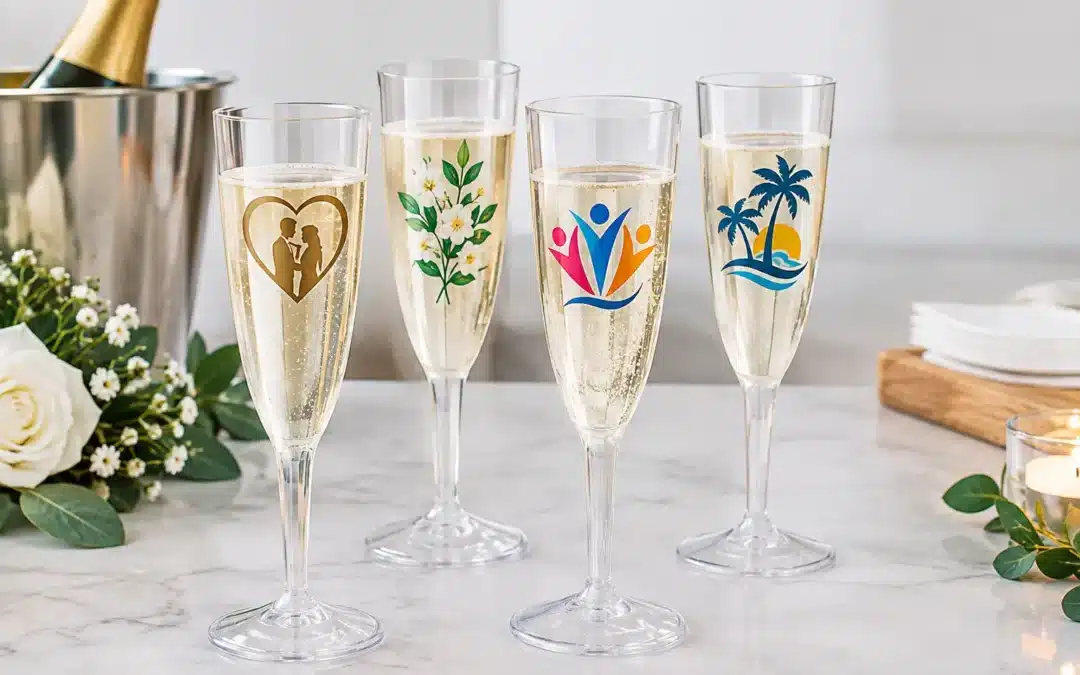
A champagne toast lasts a few minutes, but a well-designed cup can keep promoting the occasion long after the final clink. Knowing how to personalise plastic flutes means balancing the look of your artwork with the practical needs of guests, venue staff and your budget. Whether you are planning a wedding, a corporate launch, a club presentation night or a large outdoor celebration, personalised flutes turn useful eventware into a memorable branded detail.
Plastic flutes are particularly effective where glass is not suitable or practical. They are lighter to transport, safer around pools and dancefloors, and easier to manage at busy functions. The personalisation is what makes them feel considered rather than simply convenient.
Start with the occasion and the job your flutes need to do
Before choosing colours, fonts or print positions, consider how the flutes will be used. A product launch may need a bold logo that is easy to see in event photos. A wedding may call for softer typography, names and a date that guests will want to take home. For a sporting club, a durable design featuring the club crest and season details can work as both barware and merchandise.
Guest numbers matter too. If you are supplying hundreds of flutes for a festival or promotional activation, a clean one-colour design is often the most cost-effective choice and remains highly visible. Smaller runs for milestone birthdays, engagement parties or awards nights may allow more room for personalised names, detailed illustrations or a more bespoke finish.
It also helps to think about what will be poured. Sparkling wine, cocktails and non-alcoholic bubbles all suit the tall profile of a flute, but a clear cup generally offers the best visibility for artwork and the drink itself. For evening events, a strong contrast between the print colour and the drink colour will make the design easier to read.
How to personalise plastic flutes with artwork that reads clearly
The best artwork is not always the most detailed. Plastic flutes have a narrower print area than a tumbler or beer glass, so a simple, purposeful layout usually creates the strongest result. A logo, event name and date may be all that is needed.
Start with the key message. For businesses, that is usually a logo, campaign line or social handle. For personal celebrations, it may be the couple’s names, a monogram, a meaningful phrase or the event date. Decide which element must be noticed first, then build the design around it.
Avoid trying to reproduce every detail from a brochure, invitation or full brand guideline document. Fine lines, small text and complex photographic elements can lose impact when reduced to flute size. Instead, use a simplified logo variation where possible and keep type large enough to be read while someone is holding a drink.
Choose colours for contrast, not just brand consistency
Pantone-matched printing can help organisations maintain a consistent brand appearance, particularly when the flutes sit alongside signage, uniforms or other promotional items. However, the most accurate brand colour will not always be the most legible choice on a transparent vessel.
Dark ink tends to stand out well on clear plastic. White can look sharp and premium, especially for dark drinks, evening venues or elegant wedding styling. Metallic-style finishes may suit celebratory occasions, although the final effect depends on the chosen cup material, artwork and production method.
Where the design includes more than one colour, ask whether every colour is adding value. A two-colour logo can be worthwhile for a polished corporate result, while one colour may be all a large event needs. Reducing colours can simplify production and help keep a close eye on the overall spend.
Match fonts to the event, then keep them readable
Script fonts can look lovely for weddings and anniversaries, but overly fine scripts may be difficult to read when printed small. Corporate and club designs usually benefit from clear sans serif fonts or strong block lettering. If a decorative font is central to the invitation suite or campaign, use it for the names or headline and pair it with a simpler font for dates and practical information.
Capital letters can provide excellent visibility for short phrases, but a full paragraph in capitals can look crowded. Most flutes work best with a confident headline and only one or two supporting lines.
Select the right personalisation method
The right finish depends on your artwork, quantity, desired appearance and how the flutes will be handled. Your supplier should assess these factors before recommending a production approach, rather than treating every design as the same.
Printed plastic flutes are a practical choice for colourful artwork, crisp logos and event messaging. Printing is especially useful when your design relies on a specific brand colour or includes multiple solid colours. It can deliver a high-impact result for promotional campaigns, hospitality venues, community events and celebrations.
Laser etching creates a more subtle, permanent-looking mark on suitable drinkware. It can be an appealing option for sophisticated branding, commemorative pieces and designs that do not require colour. The trade-off is that laser etching does not reproduce a full-colour logo, so it is best suited to artwork that still works in a single etched tone.
For either option, provide the cleanest artwork available. Vector files are generally preferred for logos because they can be scaled without becoming fuzzy. If you only have a JPEG, PNG or screenshot, it may still be possible to work with it, but the quality of the original file affects the final result. A free digital proof is valuable here: it lets you check proportions, spelling, placement and colour direction before production begins.
Make the design useful beyond the first toast
Personalised flutes work hardest when people want to keep them. That is why practical information can be just as useful as decorative detail. A brewery might include a festival name and year. A charity could add a short campaign message. A wedding couple might use a monogram on one side and the date on the other.
For branded activations, think about the camera angle. A logo positioned on the main face of the flute is more likely to appear in guest photos than artwork tucked low near the base. If guests will be carrying flutes while networking, favour a design that can be recognised from a short distance.
For hospitality operators and clubs, reusable branded plastic flutes can also help create consistency across functions. They look more considered than generic drinkware and give members or patrons a tangible reminder of the venue after the event. In this setting, an evergreen design without a date may offer better value because it can be used again.
Plan quantities, timing and delivery early
Custom drinkware requires decisions before production can begin. Artwork approval, print setup, stock availability and freight all need to be factored into the event timeline. Ordering early gives you more choice and time to review the proof properly, especially ahead of busy wedding, Christmas and end-of-financial-year periods.
Build in a sensible buffer for guest numbers. A few extra flutes can cover breakages, unexpected attendees or guests who would like one as a keepsake. For very large events, consider whether the same design should appear across other plastic drinkware formats as well. Matching cups, wine tasters or beer glasses can make bars and service areas look coordinated without forcing every beverage into a flute.
When requesting a quote, have your preferred quantity, event date, delivery suburb, artwork file and any colour requirements ready. This gives the supplier enough information to recommend the most suitable product and decoration method from the outset. It also reduces the risk of late changes that can affect timing or cost.
Check the proof like it is the finished product
A digital proof is your chance to catch details that are easy to miss in an email attachment. Read every word aloud, including dates, web addresses, sponsor names and punctuation. Check that the logo is the correct version, the colours are appropriate and the design is centred as intended.
Look closely at the scale. Artwork that looks generous on a computer screen can appear much smaller once placed on a slender flute. If there is any doubt, ask whether the main logo or names can be enlarged. It is better to simplify before production than receive flutes where the message is technically present but difficult to notice.
For organisations with brand guidelines, nominate one person to give final sign-off. For private events, ask a friend to review the proof as well. A second set of eyes is particularly helpful for names and dates.
Personalised plastic flutes should feel effortless for guests and straightforward for organisers. With clear artwork, a suitable finish and enough time for careful proofing, they can add polish to a single celebration or keep your brand visible across event after event. PlasticGlasses.net.au can help turn an idea, logo or invitation design into drinkware that is practical, distinctive and ready for your occasion.